If you want to rank on Google, drive traffic, or grow your website, everything starts with one thing:
Keywords
But the real challenge is:
- Which keywords should you target?
- Are people actually searching for them?
- Can you rank for them?
This is where the SEMrush Keyword Planner comes in.
In this guide, you’ll learn what it is, how it works, and how beginners can use it to find high-traffic, low-competition keywords.
What Is SEMrush Keyword Planner?
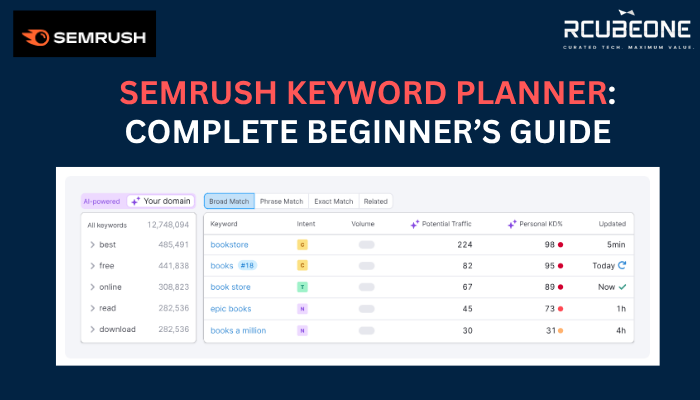
Semrush offers a powerful keyword research feature called the Keyword Magic Tool, often referred to as a keyword planner.
In simple terms:
SEMrush Keyword Planner helps you discover the best keywords to target for SEO and paid ads.
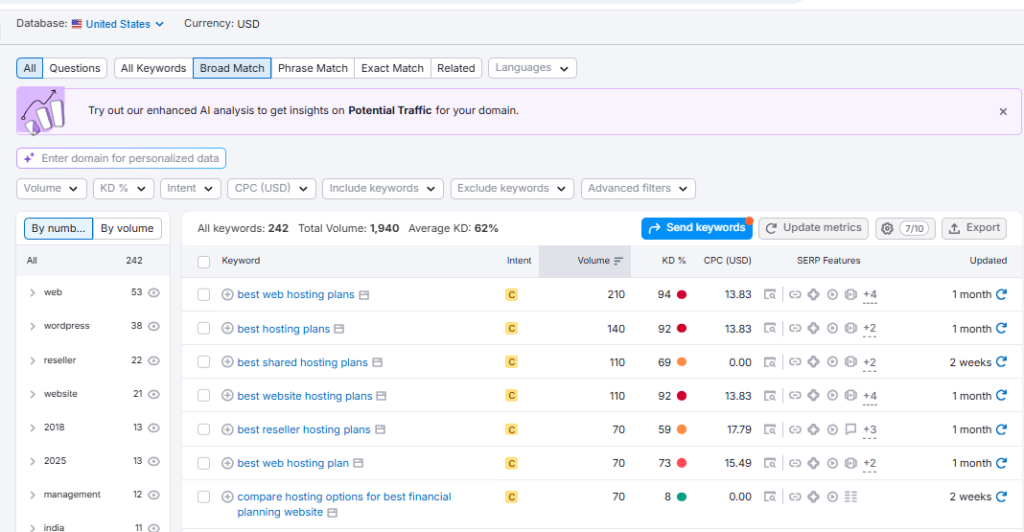
Instead of guessing, you get real data like:
- Search volume
- Keyword difficulty
- Search intent
- Cost per click (CPC)
- Competition level
This helps you create content that people are already searching for.
Why Keyword Research Matters (Especially for Beginners)
Let’s say you write a blog without keyword research.
Chances are:
- Nobody searches for it
- It doesn’t rank on Google
- You get little to no traffic
Now imagine using a tool like SEMrush:
✔ You find topics people are searching for
✔ You target low-competition keywords
✔ You improve your chances of ranking
That’s the difference between guessing and growing.
Key Features of SEMrush Keyword Planner
Let’s break down the most useful features in simple language.
1. Discover Keyword Variations
With just one keyword, you can generate thousands of ideas:
- Broad match keywords
- Phrase match keywords
- Exact match keywords
- Long-tail keywords
- Question-based keywords
Example:
Search “web hosting” → You’ll get:
- best web hosting for beginners
- cheap web hosting plans
- how to choose hosting
- web hosting comparison
This helps you create multiple content ideas from one topic.
2. Filter and Refine Keywords
Not all keywords are worth targeting.
SEMrush lets you filter based on:
- Search volume
- Keyword difficulty
- Word count
- CPC
- Specific words (include/exclude)
This helps you focus only on keywords that actually matter.
3. Understand Search Intent
Search intent tells you why someone is searching.
SEMrush categorizes keywords into:
- Informational (learn something)
- Navigational (find a site)
- Transactional (buy something)
- Commercial (compare options)
Example:
“Best hosting plan” → Commercial
“Buy hosting” → Transactional
This helps you create content that matches user intent – a key Google ranking factor.
4. Analyze Keyword Metrics
For every keyword, you get detailed insights:
- Search Volume → How many people search monthly
- Keyword Difficulty → How hard it is to rank
- CPC (Cost Per Click) → Advertising value
- Trend Data → Popularity over time
- SERP Features → Featured snippets, ads, etc.
- Competition Density → Advertiser competition
These metrics help you choose the right keywords strategically.
5. Discover Content Ideas
The tool also helps you:
- Find trending topics
- Identify popular questions
- Explore related themes
This is extremely useful for:
- Blog planning
- YouTube content
- SEO articles
- Affiliate content
6. Analyze Real Search Results
You can see:
- Top-ranking pages on Google
- Competitor content
- Ranking difficulty
This helps you understand what kind of content is already working — and how to improve on it.
How to Use SEMrush Keyword Planner (Step-by-Step)
Here’s a simple process beginners can follow:
Step 1: Enter a Seed Keyword
Start with a basic idea.
Example: “fitness”, “hosting”, “SEO tools”
Step 2: Explore Keyword Suggestions
Review the generated list and identify:
- Relevant keywords
- Long-tail opportunities
- Questions
Step 3: Analyze Metrics
Focus on:
- Good search volume
- Low to medium difficulty
- Clear search intent
Step 4: Select Keywords
Choose keywords that match your content goals.
Step 5: Use Keywords in Content
Add them to:
- Blog titles
- Headings
- Meta descriptions
- Content naturally
That’s it – simple and effective.
What You Can Do with SEMrush Keyword Planner
Here’s how it helps in real-world scenarios:
✔ Build a Complete Keyword Strategy
Plan your content using data, not guesswork.
✔ Find Long-Tail Keywords
Target less competitive keywords that are easier to rank.
✔ Improve SEO Rankings
Choose keywords that align with Google’s ranking factors.
✔ Optimize Paid Campaigns
Use CPC and competition data for ads.
✔ Track and Expand Keyword Lists
Send selected keywords to tracking and strategy tools.
Is SEMrush Keyword Planner Free?
Yes-but with limits.
You can:
✔ Use it up to 10 searches per day (free account)
✔ Access basic keyword data
✔ Explore keyword ideas
For deeper insights and unlimited usage, you’ll need a paid plan.
How SEMrush Uses AI for Keyword Research
SEMrush combines:
- A massive keyword database
- AI models (LLMs)
- Real-time search data
This allows it to:
- Suggest relevant keywords
- Calculate personalized keyword difficulty
- Estimate traffic potential
- Match keywords to your domain
This makes your keyword research smarter and more personalized.
Global Keyword Data Availability
SEMrush provides keyword data for 120+ countries, including:
- United States
- United Kingdom
- India
- Canada
- Germany
- France
- Spain
This is especially useful if you’re targeting international audiences.
SEMrush vs Traditional Keyword Tools
Compared to basic tools like Google Keyword Planner, SEMrush offers:
✔ More keyword variations
✔ Better filtering options
✔ Competitor insights
✔ Advanced metrics
✔ AI-powered recommendations
Who Should Use SEMrush Keyword Planner?
This tool is perfect for:
- Bloggers
- SEO beginners
- Affiliate marketers
- Agencies
- Business owners
- YouTubers
If you want traffic from Google, this tool is highly valuable.
Final Thoughts: Is SEMrush Keyword Planner Worth It?
If you want to grow your website with SEO, keyword research is non-negotiable.
And SEMrush makes that process:
- Faster
- Smarter
- Data-driven
Simple Summary:
- Helps you find the right keywords
- Shows real search data
- Improves content strategy
- Increases chances of ranking
If you’re serious about SEO, learning this tool can give you a strong advantage.